HTML5 and Atom Gone Wrong
This week the W3C HTML WG finally made the sensible decision to remove the Atom conversion algorithm from HTML5. It should never have been included in the specification in the first place, so I genuinely am grateful to those that fought to have it removed.
That doesn’t mean I can’t still have a good laugh at how truly awful the algorithm was now that it’s gone. So with that in mind, I’m proud to present:
The HTML5 Atom Spot-the-Difference Competition
Of the two feeds below, one is valid Atom, and the other a bastardisation of Atom as might be produced by the HTML5 algorithm. For those of you that have never played this sort of game before, the idea is to identify the nine differences between the two feeds.
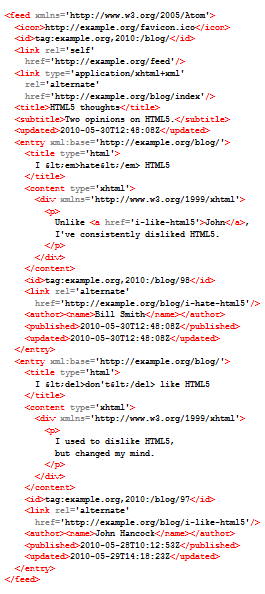
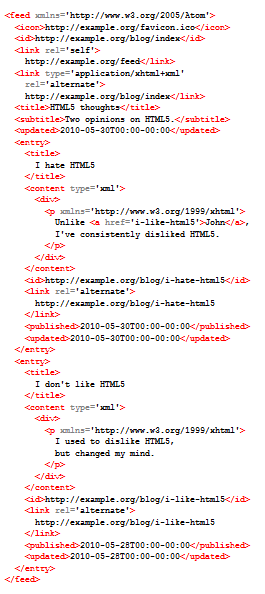
I’ve presented the feeds as images to make things a little more challenging and to discourage the use of the feed validator or file comparison tools. However, if you really need it, the source XML can be obtained by following the longdesc links on each image.
At least be grateful that I’m not asking you to read through the pages and pages of incomprehensible HTML5 pseudocode that I had to endure.
The Prize
The first correct set of answers drawn wins a pay-your-own-way trip to the sunny city of London, England, and a chance to meet yours truly in some dodgy London nightclub.
Prize doesn’t include cost of travel, accommodation, entrance to dodgy nightclub, or anything at all. Chances of actually meeting me are virtually nil. Entries must be received by midnight of April 1st, 2010. Entrants must be over 18 years of age and legal residents of the planet of Thundera.
Answers
- The URLs for
atom:linkelements should be stored in thehrefattribute and not in the link content. - The values used for
atom:idshould be both stable and unique. Using a copy of the permalink meets neither requirement. - Stripping the markup from
atom:titleelements has resulted in one title changing its meaning entirely. - The
typeattribute onatom:contentelements should be xhtml for XHTML content, and not xml. - The XHTML
divelement that is an immediate child ofatom:contentis not correctly namespaced. - The dates in the
atom:publishedelements are incorrectly formatted and in the wrong timezone. - The
atom:updatedelements are merely duplicates of theatom:publishedelements, failing to detect the correct update times. - Without an
xml:baseattribute, relative URLs inside theatom:contentelements will not be correctly resolved. - The
atom:authorelements are missing altogether since the algorithm is only capable of recognising feed-level authors, at best.